Muhammad_salaar
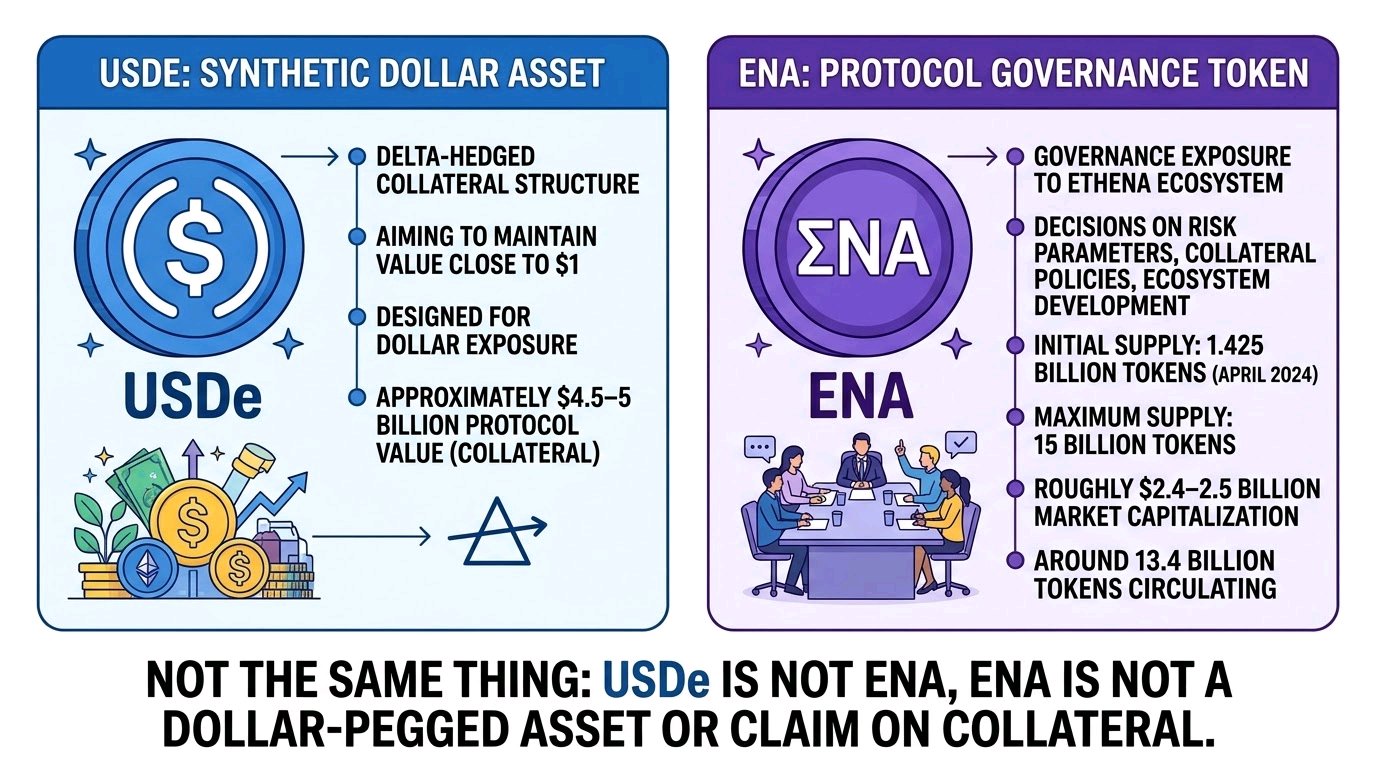
BEAM may look like a privacy-focused cryptocurrency, but the BEAM gaming token represents something entirely different: exposure to a blockchain gaming ecosystem, not confidential payments. BEAM emerged in October 2023 through a 1:100 migration from Merit Circle's original MC token, which launched in November 2021. Its maximum supply is approximately 58.47 billion tokens, with no independent token issuance during the migration. Blockworks +1 That distinction is easy to miss if you only read the headline. BEAM is the utility and governance token of the Beam Network. It is used for transaction fees, ecosystem payments, governance and network participation. It does not represent company equity, guaranteed profits, ownership of gaming projects or a claim on an underlying asset. Its market price depends on token demand, ecosystem activity and supply dynamics, not a fixed redemption value. docs.onbeam.com +1 The scale matters. Beam operates as a gaming-focused blockchain built using Avalanche technology, connecting games, developers, marketplaces and digital assets. Holding BEAM therefore creates exposure to the economic activity and adoption of that ecosystem, rather than ownership of the games themselves. CA Crypto Asset Statement +1 BEAM is not a claim on gaming revenue; it is a token tied to the ecosystem. The difference is what you are actually holding. #ByXIMPACT $BEAMUSDT
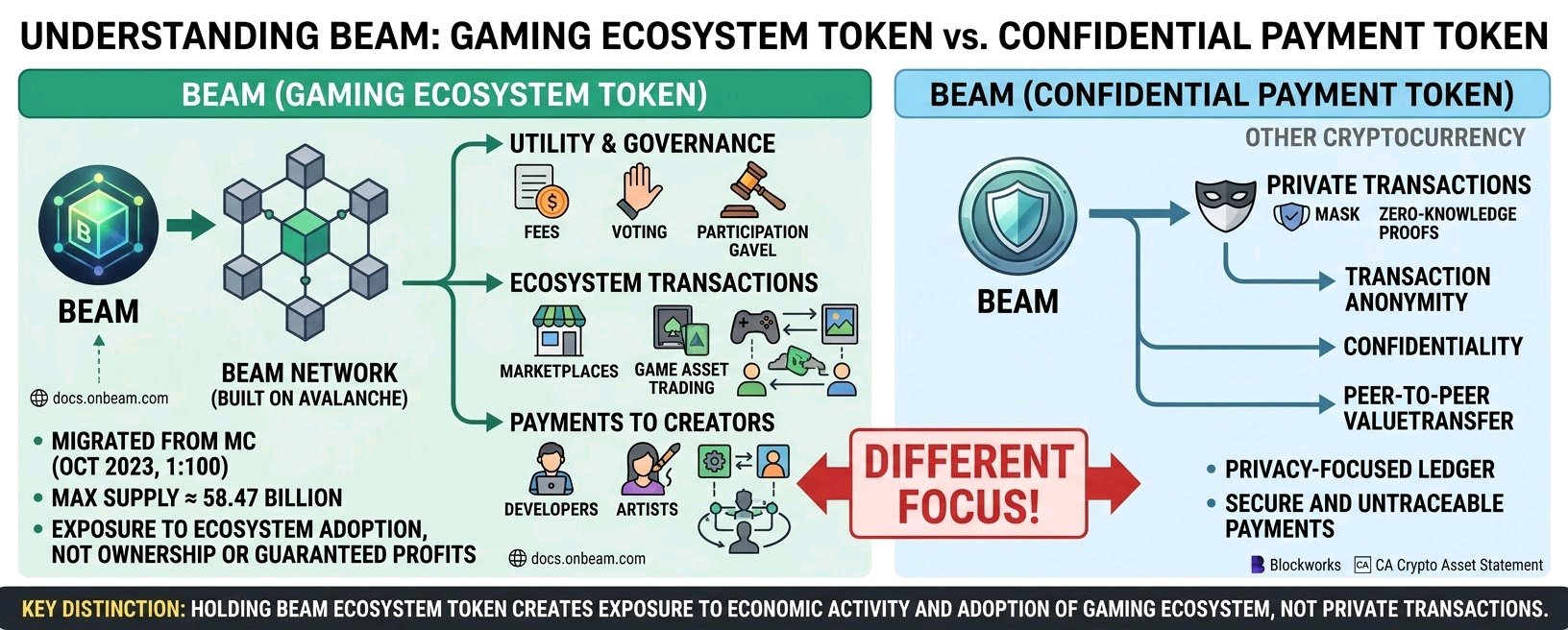
ENA may be associated with Ethena’s synthetic dollar system, but it is neither a dollar-pegged asset nor a direct claim on the protocol’s collateral. Launched in April 2024, ENA started with an initial circulating supply of 1.425 billion tokens and a maximum supply of 15 billion. Its primary role is protocol governance, including decisions around risk parameters, collateral policies, and ecosystem development. That distinction is easy to miss if you only read the headline. USDe is designed to maintain a value close to $1 through a delta-hedged collateral structure. ENA, by contrast, represents governance exposure to the Ethena ecosystem. Holding ENA does not give you a fixed-dollar redemption right, ownership of USDe reserves, or an automatic claim on protocol revenue. The scale makes the distinction clearer. Ethena has approximately $4.5–5 billion in protocol value, while ENA has a market capitalization of roughly $2.4–2.5 billion, with around 13.4 billion tokens circulating. A large protocol does not automatically make its governance token equivalent to the assets that support its stablecoin. USDe is designed for dollar exposure. ENA is exposure to the protocol's governance and ecosystem. Same ecosystem, two very different things you are actually holding. #ByXIMPACT $ENAUSDT
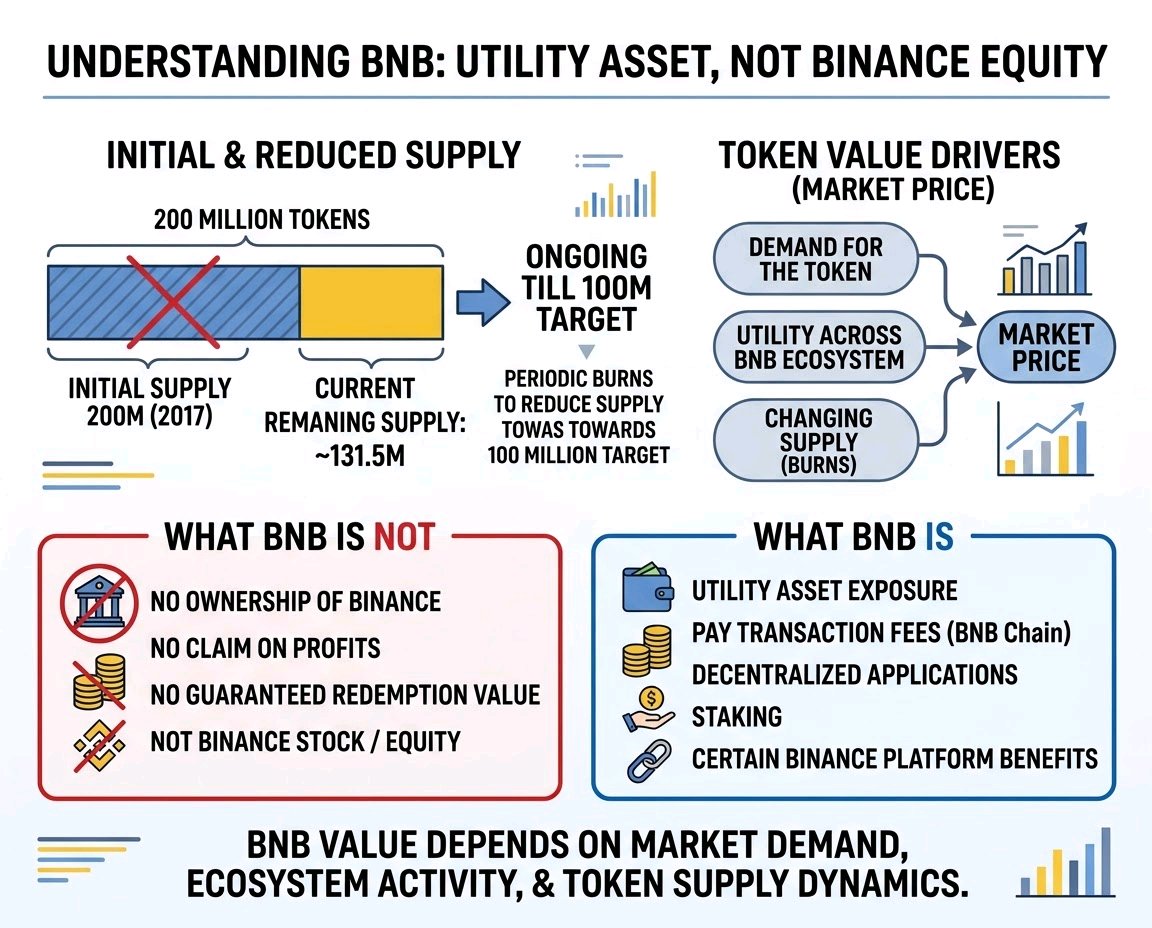
BNB may look like an investment in Binance, but it is neither Binance stock nor a token with a fixed dollar value. Its market price is driven by demand for the token, its utility across the BNB ecosystem, and its changing supply. BNB launched in 2017 with an initial supply of 200 million tokens. Of that amount, 100 million were sold through its ICO, while the remaining supply was allocated to Binance’s team and early investors. Its supply is designed to decline toward a 100 million token target through scheduled and ongoing burns. Binance +2 That distinction is easy to miss if you only read the headline. Holding BNB does not give you ownership of Binance, a claim on its profits, or a guaranteed redemption value. It gives you exposure to a utility asset used for BNB Chain transaction fees, staking, decentralized applications, and certain Binance platform benefits. Its value depends on market demand, ecosystem activity, and token supply dynamics. With approximately 131.5 million BNB remaining against an original 200 million, the supply reduction is substantial, but burns do not guarantee price appreciation. Unlike company shares, BNB represents exposure to a blockchain ecosystem, not ownership of the exchange behind its name. Binance +1 BNB is not Binance equity. It is exposure to the ecosystem through the token you are actually holding. #ByXIMPACT$BNBUSDT
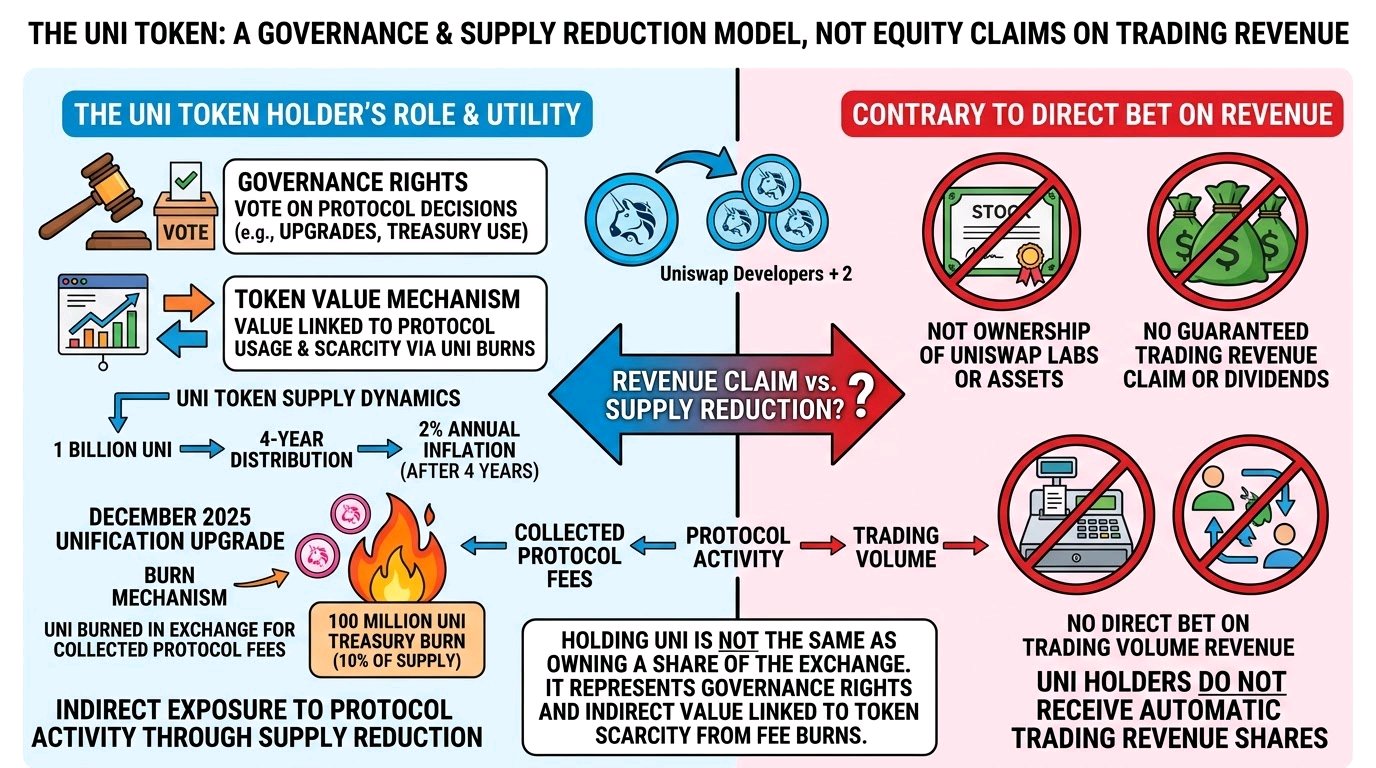
UNI may look like a direct bet on Uniswap’s trading volume, but holding UNI is not the same as owning a share of the exchange or receiving automatic trading revenue. The UNI token launched in September 2020 with an initial supply of 1 billion tokens, distributed among community members, contributors, investors, and advisors. Its design also includes a scheduled annual inflation rate of 2% after the initial four-year period. That distinction is easy to miss if you only read the headline. UNI is primarily a governance token for the Uniswap protocol. It gives holders governance rights over protocol decisions, but owning UNI does not automatically mean owning Uniswap Labs, its business assets, or a guaranteed claim on every trading fee generated by the platform. The scale matters. Uniswap launched with 1 billion UNI, and its December 2025 UNIfication upgrade introduced a mechanism that burns UNI in exchange for collected protocol fees. A separate 100 million UNI treasury burn represented 10% of the original supply. This creates an indirect link between protocol usage and token scarcity, not a direct dividend for holders. Uniswap Developers +2 UNI is therefore more than a governance label, but it is not an equity claim on Uniswap’s trading business. You are holding governance rights and indirect exposure to protocol activity through supply reduction, not a guaranteed share of revenue. The difference is between owning a claim on revenue and holding a token whose supply can shrink. #ByXIMPACT $UNIUSDT
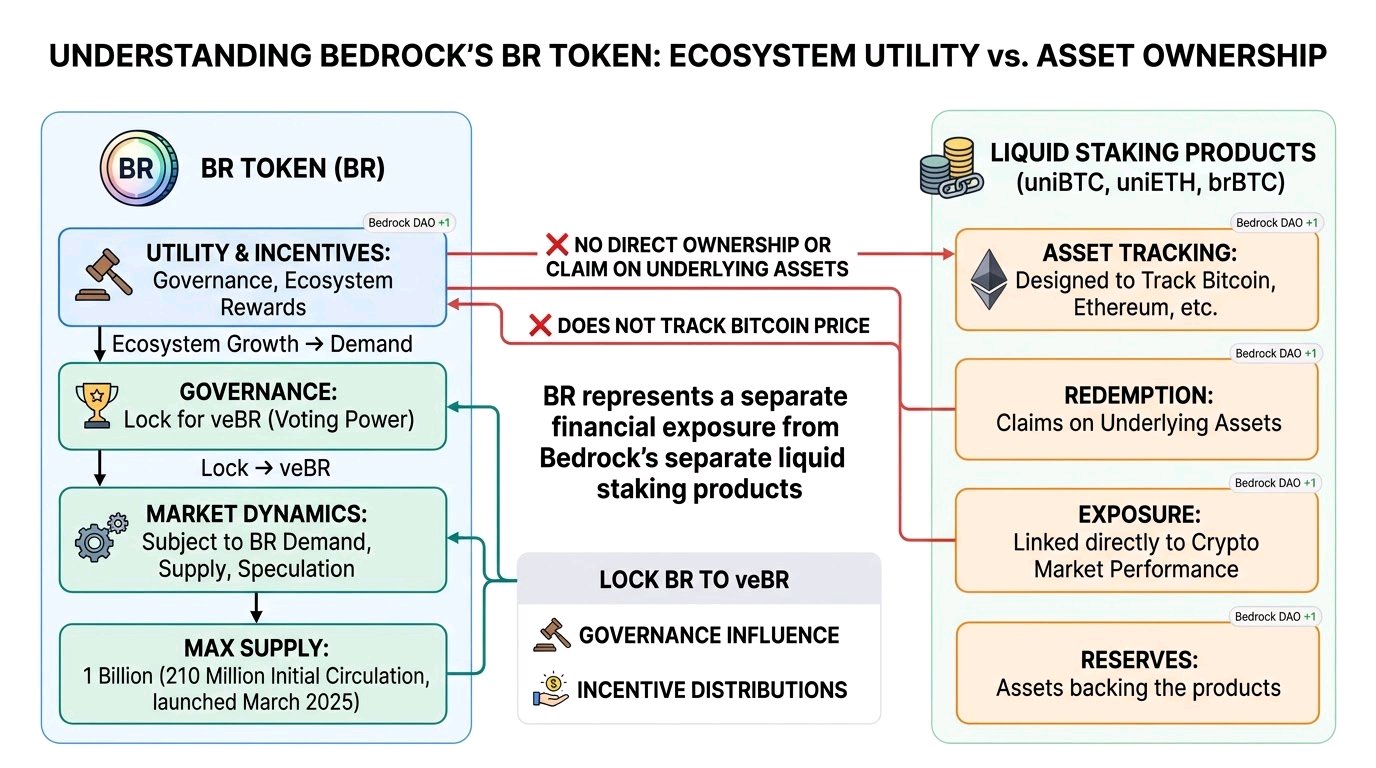
Bedrock’s BR may look like a Bitcoin-related asset because of its name and ecosystem, but it does not represent ownership of Bitcoin or a claim on deposited crypto assets. Launched in March 2025, BR has a maximum supply of 1 billion tokens, with approximately 210 million initially circulating. Its role is centered on governance, utility, and ecosystem incentives. That distinction is easy to miss if you only read the headline. BR holders are exposed to the token’s own market demand, supply dynamics, governance utility, and Bedrock ecosystem growth. Locking BR into veBR provides governance influence and access to incentive distributions. It does not give holders direct ownership of the underlying assets in Bedrock’s liquid staking products. Unlike Bedrock’s separate uniBTC, uniETH, and brBTC products, BR is not designed to track or redeem for Bitcoin, Ethereum, or another underlying asset. Its value depends on demand for the governance token, ecosystem participation, and expectations surrounding future utility. Bedrock DAO +1 With a 1 billion maximum supply and an initial circulation of 210 million, BR also has its own supply and distribution dynamics. This makes it a separate financial exposure from the assets and staking products operating within Bedrock’s ecosystem. Bedrock DAO +1 The distinction is simple: exposure to Bedrock’s ecosystem is not ownership of the assets inside it. What matters is what you are actually holding. #ByXIMPACT$BRUSDT
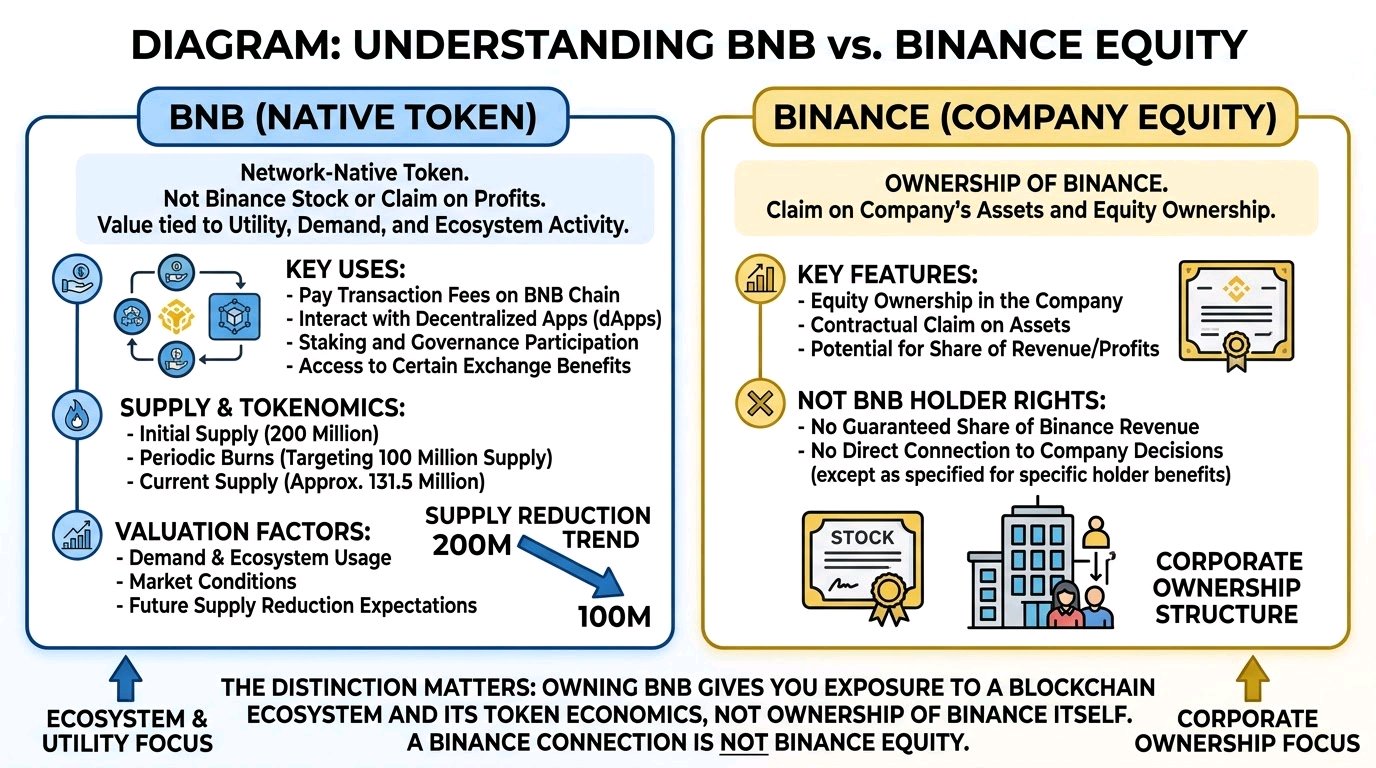
BNB may look like a direct bet on Binance, but it is neither Binance stock nor a claim on the company's profits. It is a network-native token whose value is tied to utility, demand, and activity across the BNB ecosystem. BNB launched in July 2017 with an initial supply of 200 million tokens, following Binance's ICO. Its tokenomics include periodic burns designed to reduce the supply toward a target of 100 million BNB. That distinction is easy to miss if you only read the headline. BNB is used to pay transaction fees on BNB Chain, interact with decentralized applications, participate in staking and governance, and access certain Binance exchange benefits. Holders do not receive equity ownership, a contractual claim on Binance's assets, or a guaranteed share of its revenue. Its original 200 million supply has fallen to approximately 131.5 million, with burns targeting 100 million. Unlike a stablecoin, BNB has no fixed-dollar redemption promise. Its market price depends on demand, ecosystem usage, market conditions, and expectations around future supply reduction. Binance +2 The distinction matters: owning BNB gives you exposure to a blockchain ecosystem and its token economics, not ownership of Binance itself. A Binance connection is not Binance equity. What matters is what you are actually holding. #ByXIMPACT $BNBUSDT
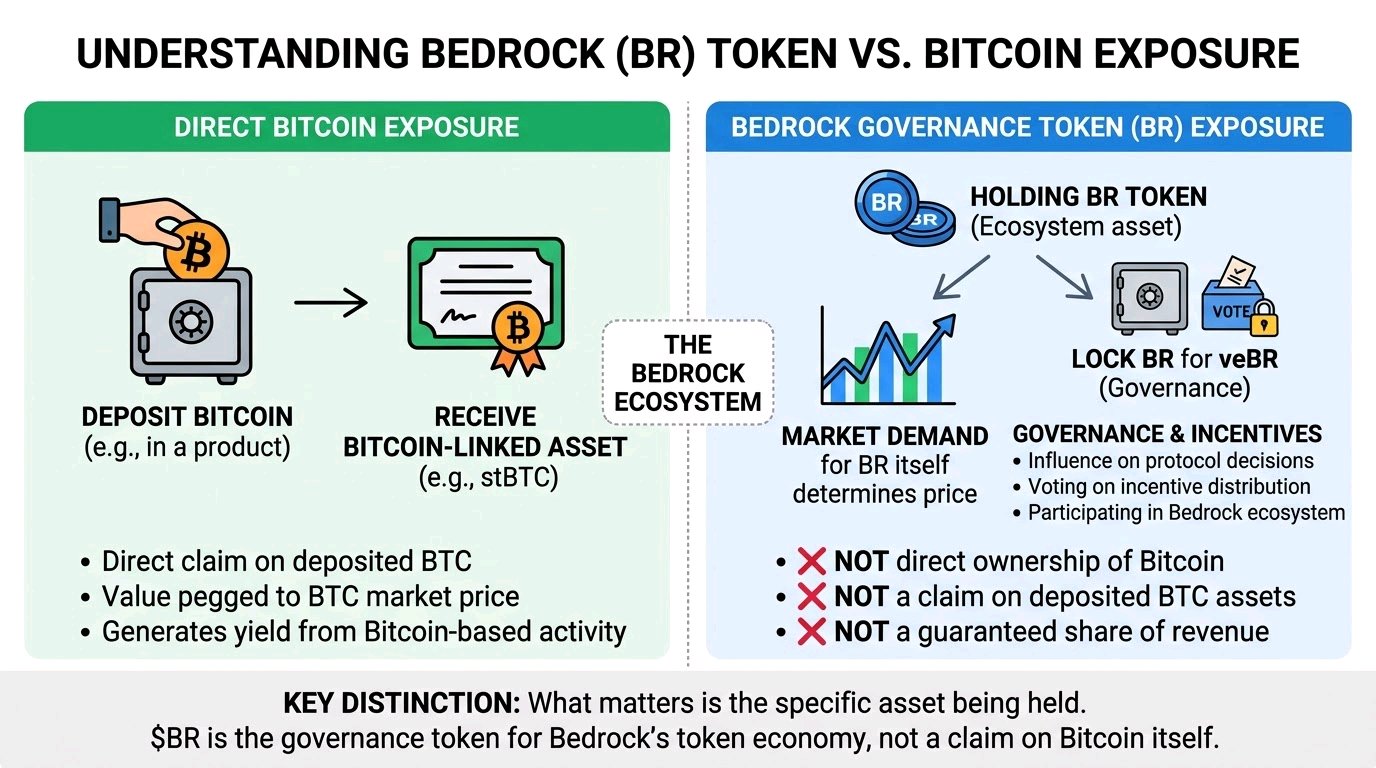
may look like a way to gain exposure to Bitcoin yield through Bedrock, but it is not Bitcoin-backed ownership or a claim on deposited BTC. Bedrock launched BR on March 19, 2025, with a maximum supply of 1 billion tokens and an initial circulating supply of approximately 210 million. Its primary role is governance, ecosystem incentives, and participation in the Bedrock protocol. Bedrock DAO +1 That distinction is easy to miss if you only read the headline. BR represents exposure to Bedrock's token economy, not direct ownership of Bitcoin, deposited assets, or a guaranteed share of protocol revenue. Holders can lock BR to receive veBR, gaining governance influence over protocol decisions and incentive distribution. Its market price is determined by demand for BR itself, not by a fixed redemption value against BTC. Bybit +1 The distinction matters because Bedrock's Bitcoin products and its governance token occupy different positions in the same ecosystem. A user depositing BTC into a Bedrock product receives exposure through the relevant Bitcoin-linked product, while holding BR means taking exposure to the protocol's own token economy. Even with a 1 billion token supply, BR does not become a Bitcoin claim. Bitcoin yield exposure and Bedrock token exposure are two different things. What matters is what you are actually holding. #ByXIMPACT $BRUSDT
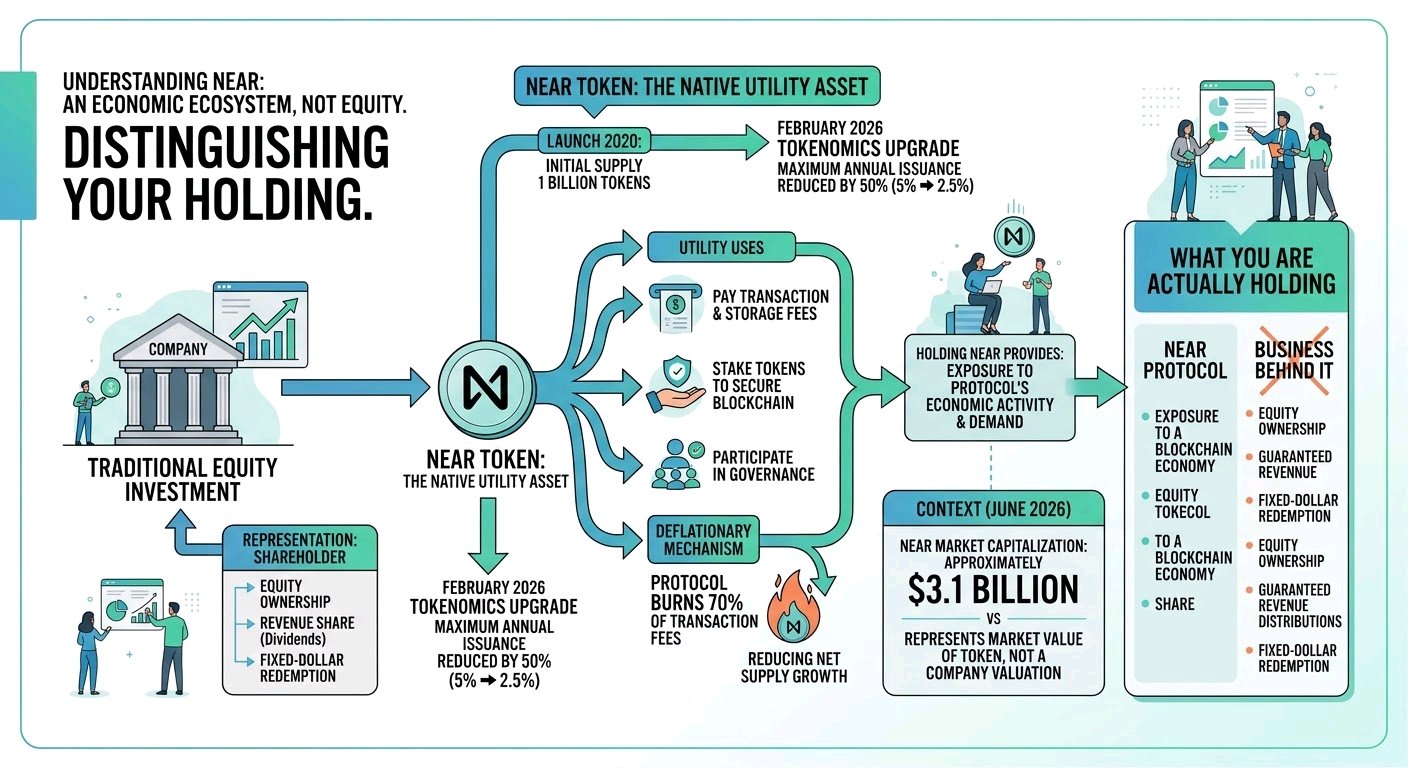
NEAR may look like a direct investment in the NEAR ecosystem, but its price does not represent ownership in the companies building it or a claim on their revenue. NEAR Protocol launched in 2020 with an initial supply of 1 billion tokens. Following a February 2026 tokenomics upgrade, maximum annual issuance was reduced by 50%, from 5% to 2.5%. That distinction is easy to miss if you only read the headline. NEAR is the network’s native utility asset. Holders use it to pay transaction and storage fees, stake tokens to help secure the blockchain, and participate in governance. The protocol also burns 70% of transaction fees, reducing the net supply growth. This means holding NEAR provides exposure to the economic activity and demand surrounding the protocol, not equity ownership, guaranteed revenue distributions, or a fixed-dollar redemption right. For context, NEAR had a market capitalization of approximately $3.1 billion as of June 2026. That figure represents the market value of the token, not the valuation of a company or the value of assets backing each coin. NEAR is exposure to a blockchain economy, not ownership of the business behind it. The difference is what you are actually holding. #ByXIMPACT $NEARUSDT
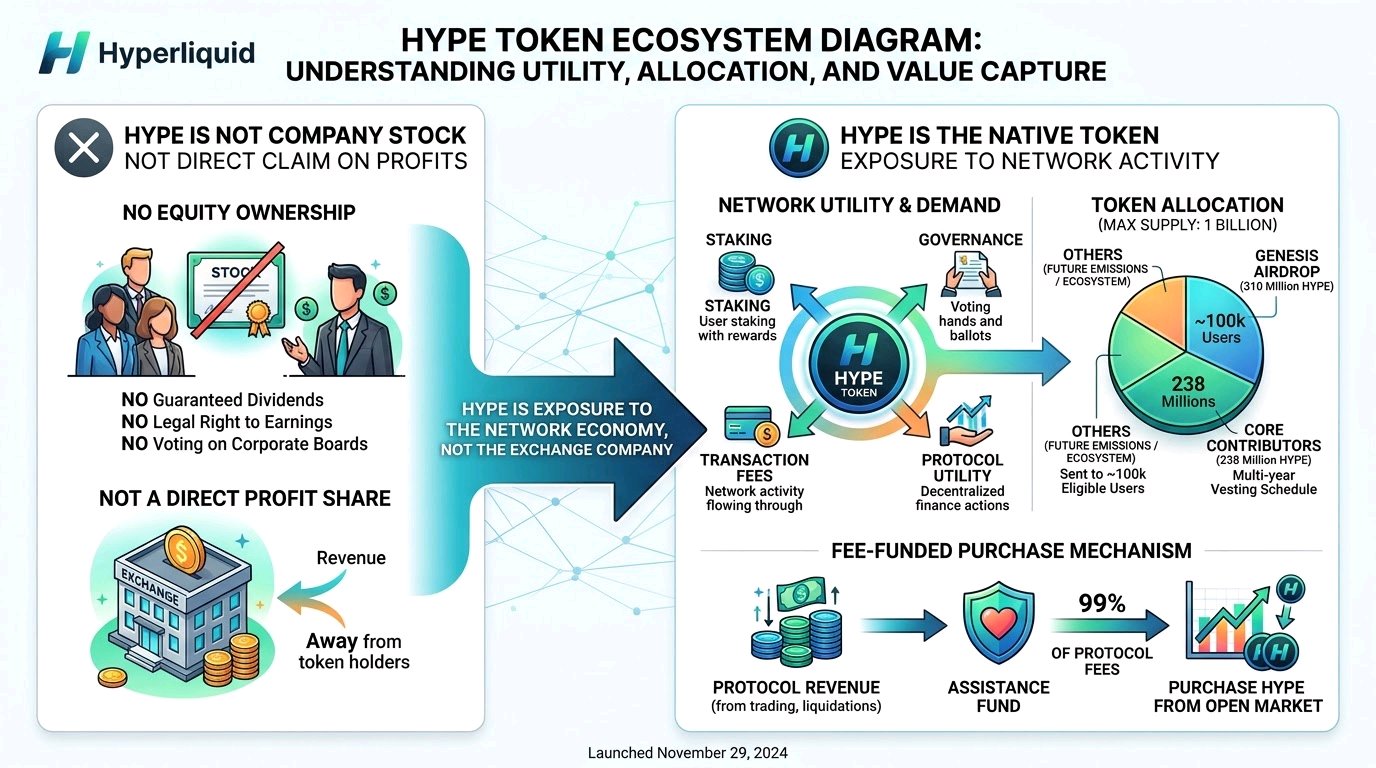
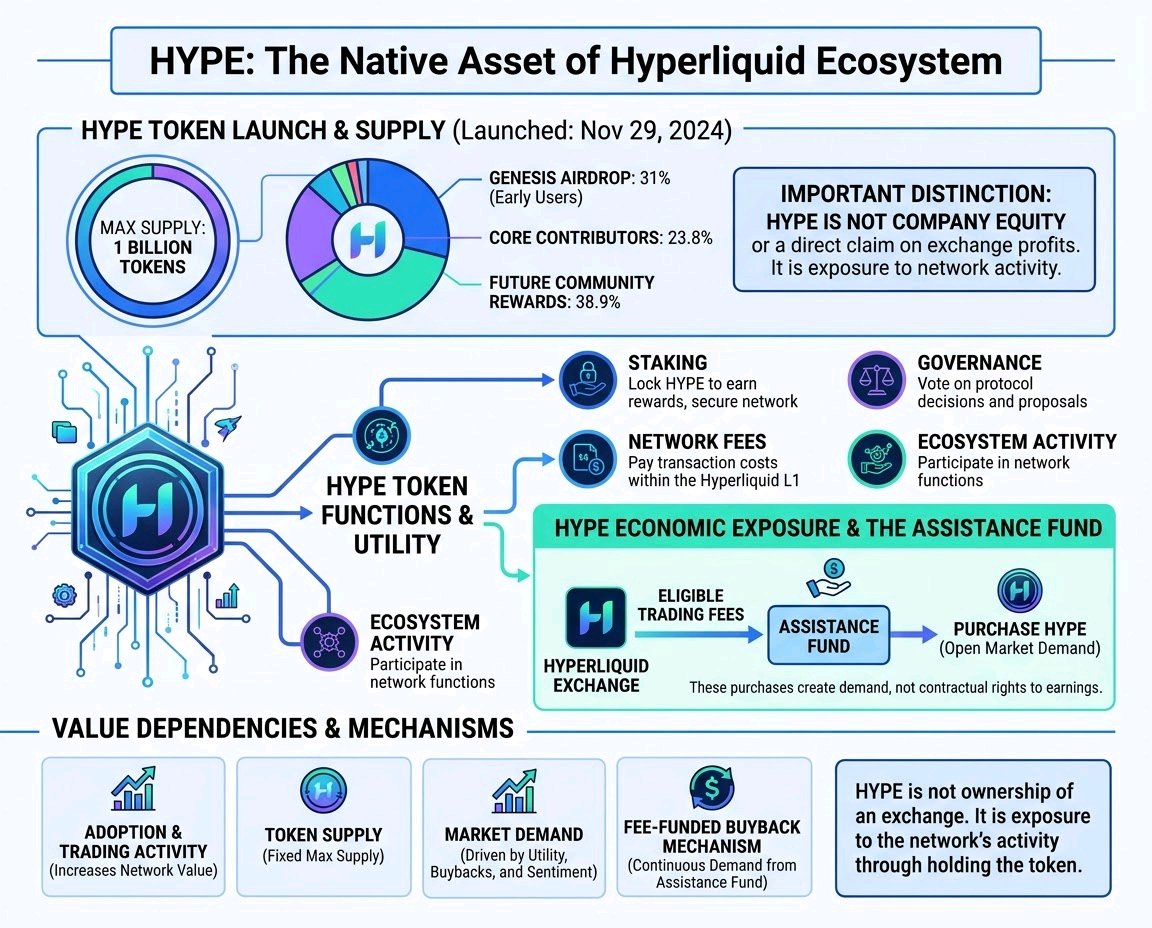
HYPE may look like a bet on Hyperliquid's success, but it is not company equity or a direct claim on exchange profits. HYPE launched on November 29, 2024, with a maximum supply of 1 billion tokens. Around 31% was distributed to early users through its genesis airdrop, while 23.8% was allocated to core contributors and 38.9% reserved for future community rewards. SEC +1 That distinction is easy to miss if you only read the headline. HYPE is the native asset of the Hyperliquid ecosystem. It supports staking, governance, network fees and ecosystem activity. Its economic exposure comes partly from protocol revenue: eligible trading fees flow into the Assistance Fund, which uses them to purchase HYPE from the open market. These purchases create demand, but they do not give holders contractual rights to company earnings or guaranteed distributions. Coinbase Institutional Market Intelligence +1 At a 1 billion token maximum supply, HYPE combines network utility, staking incentives and a fee-funded buyback mechanism. But its value still depends on adoption, trading activity, token supply and market demand. HYPE is not ownership of an exchange. It is exposure to the network's activity through the token you are actually holding. #ByXIMPACT $HYPEUSDT
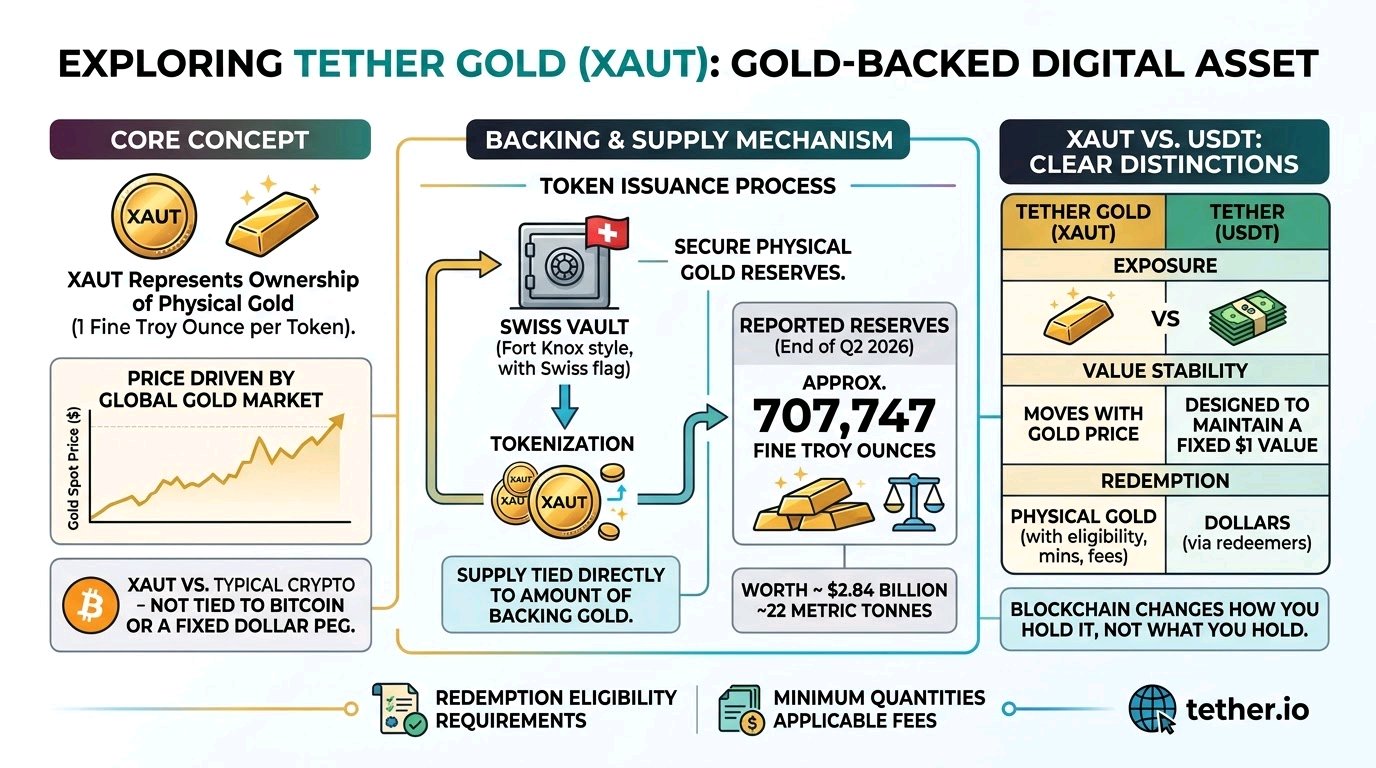
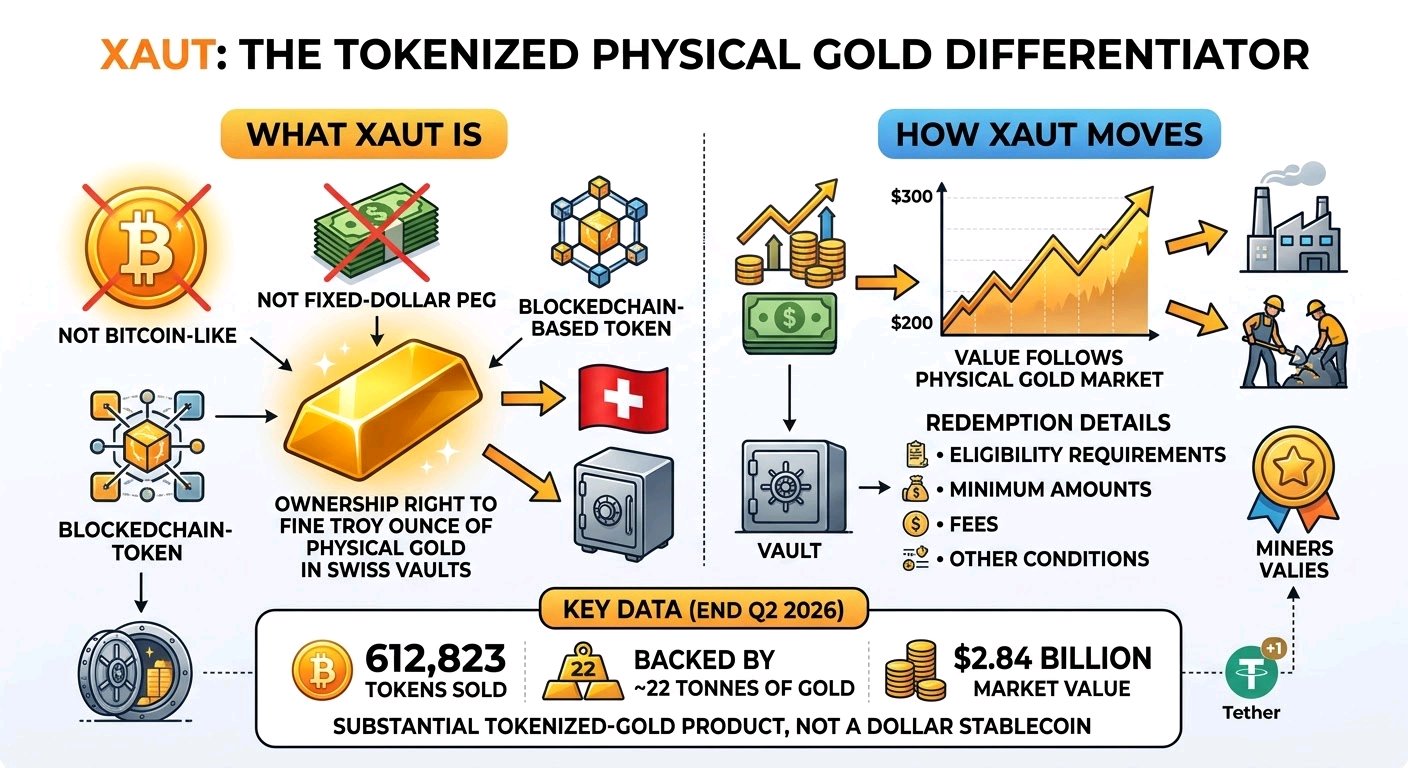
XAUT may look like another crypto asset, but it does not track Bitcoin or a fixed dollar peg. It represents ownership rights to physical gold, with its price driven primarily by the market value of gold. Launched in 2020, Tether Gold (XAUT) represents one fine troy ounce of physical gold per token, held in Swiss vaults. Its supply is tied to the amount of gold backing the tokens rather than an independently fixed issuance target. That distinction is easy to miss if you only read the headline. Each token gives the holder exposure to one ounce of gold, not one dollar. Unlike USDT, XAUT is not designed to maintain a fixed $1 value. Its value moves with gold prices, while physical redemption is subject to eligibility requirements, minimum quantities and applicable fees. By the end of Q2 2026, Tether reported approximately 707,747 fine troy ounces of gold reserves, worth around $2.84 billion. That is roughly 22 metric tonnes of physical gold held in Swiss vaults. tether.io +1 The difference is straightforward: USDT represents dollar exposure, while XAUT represents gold exposure. The blockchain changes how you hold it, not what you are actually holding. #ByXIMPACT $XAUTUSDT
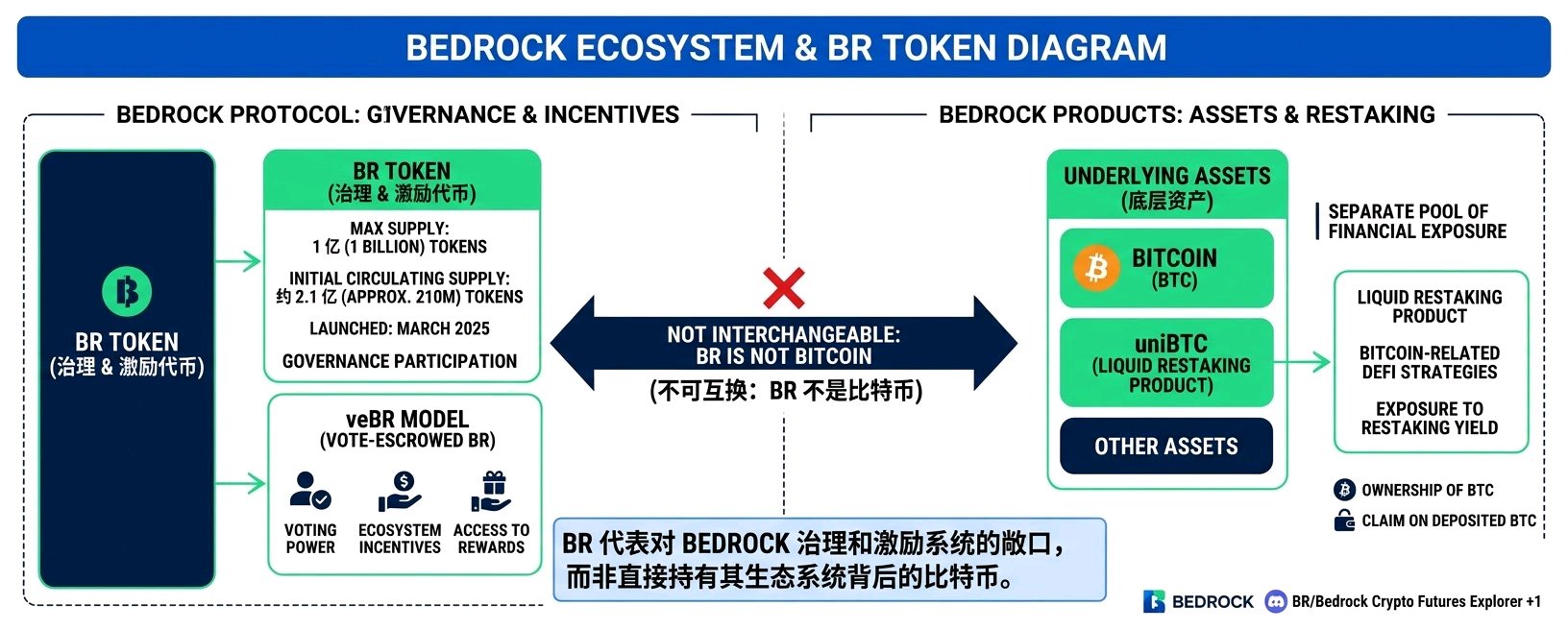
Bedrock’s BR may look like a direct bet on Bitcoin and restaking, but holding BR is not the same as holding Bitcoin or earning Bitcoin staking yield. Launched in March 2025, BR has a fixed maximum supply of 1 billion tokens, with an initial circulating supply of approximately 210 million. It serves as the governance and incentive token of the Bedrock ecosystem. Phemex +1 That distinction is easy to miss if you only read the headline. Bedrock provides liquid restaking products such as uniBTC, which gives users exposure to Bitcoin-related DeFi strategies. BR operates on a different layer: it provides governance participation and access to ecosystem incentives, including through its vote-escrow model, veBR. Holding BR does not automatically give someone ownership of Bitcoin, a claim on deposited BTC, or guaranteed restaking returns. BR/Bedrock Crypto Futures Explorer +1 The scale matters. Bedrock's 1 billion BR supply represents the token economics of the protocol, while the Bitcoin and other assets used in its restaking products represent a separate pool of underlying financial exposure. Their risks, pricing mechanisms and economic claims are not interchangeable. BR represents exposure to Bedrock's governance and incentive system, not direct ownership of the Bitcoin behind its ecosystem. $BRUSDT #ByXIMPACT
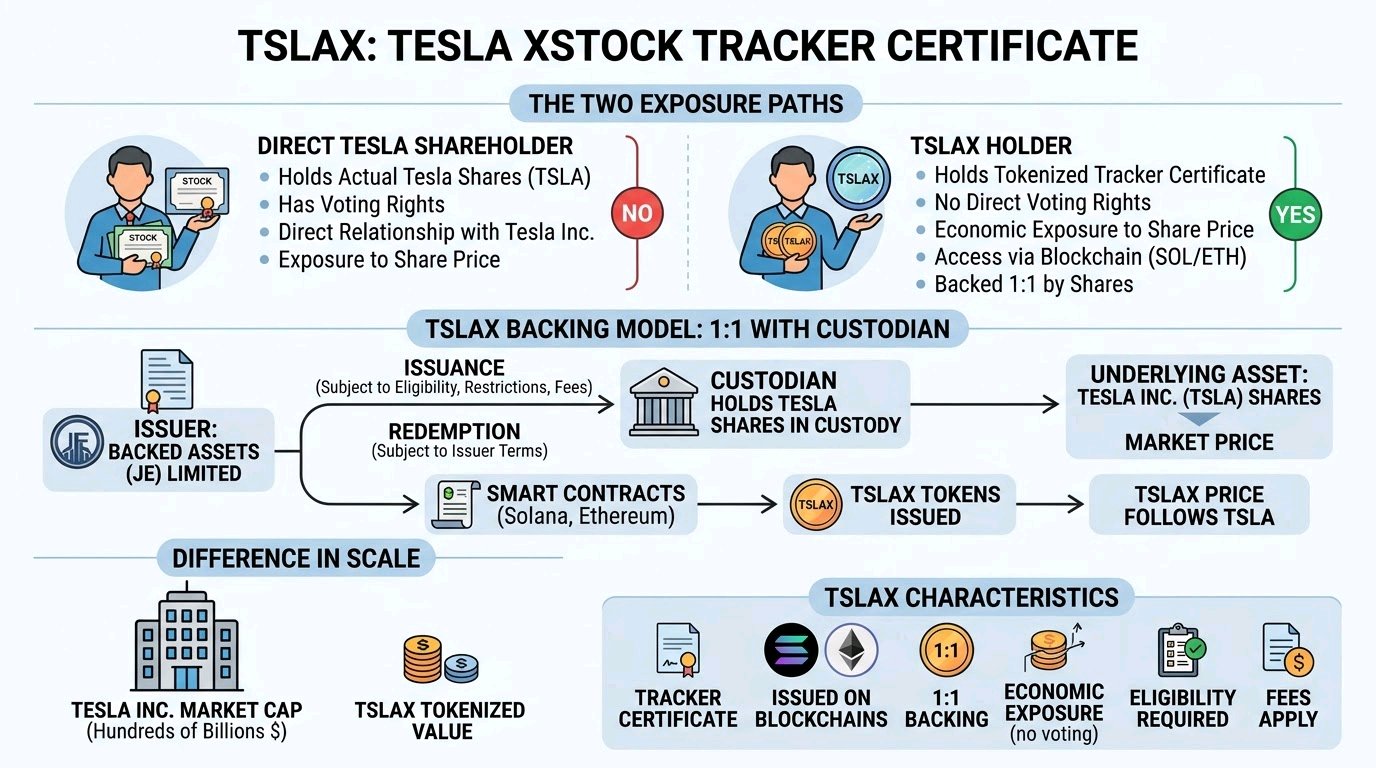
TSLAX may look like another Tesla-themed crypto token, but it does not represent a bet on a blockchain project. It provides price exposure to Tesla stock through a tokenized financial instrument. Issued by Backed Assets (JE) Limited, Tesla xStock is structured as a tracker certificate and issued on Solana and Ethereum. Its model uses 1:1 backing with Tesla shares held in custody. That distinction is easy to miss if you only read the headline. TSLAX does not make holders direct Tesla shareholders. It represents economic exposure to Tesla's share price through a tokenized certificate. Holders do not receive direct shareholder voting rights, and issuance and redemption are subject to eligibility requirements, restrictions, fees, and issuer terms. The scale also matters. Tesla is a publicly traded company with a market capitalization measured in hundreds of billions of dollars, while TSLAX represents a much smaller tokenized access channel to its equity value. Its price follows Tesla's stock, not an independent crypto supply-and-demand narrative. Same Tesla exposure, different financial instrument. You are not holding Tesla shares directly; you are holding a tokenized claim tied to their economic value. $TSLAXUSDT #ByXIMPACT
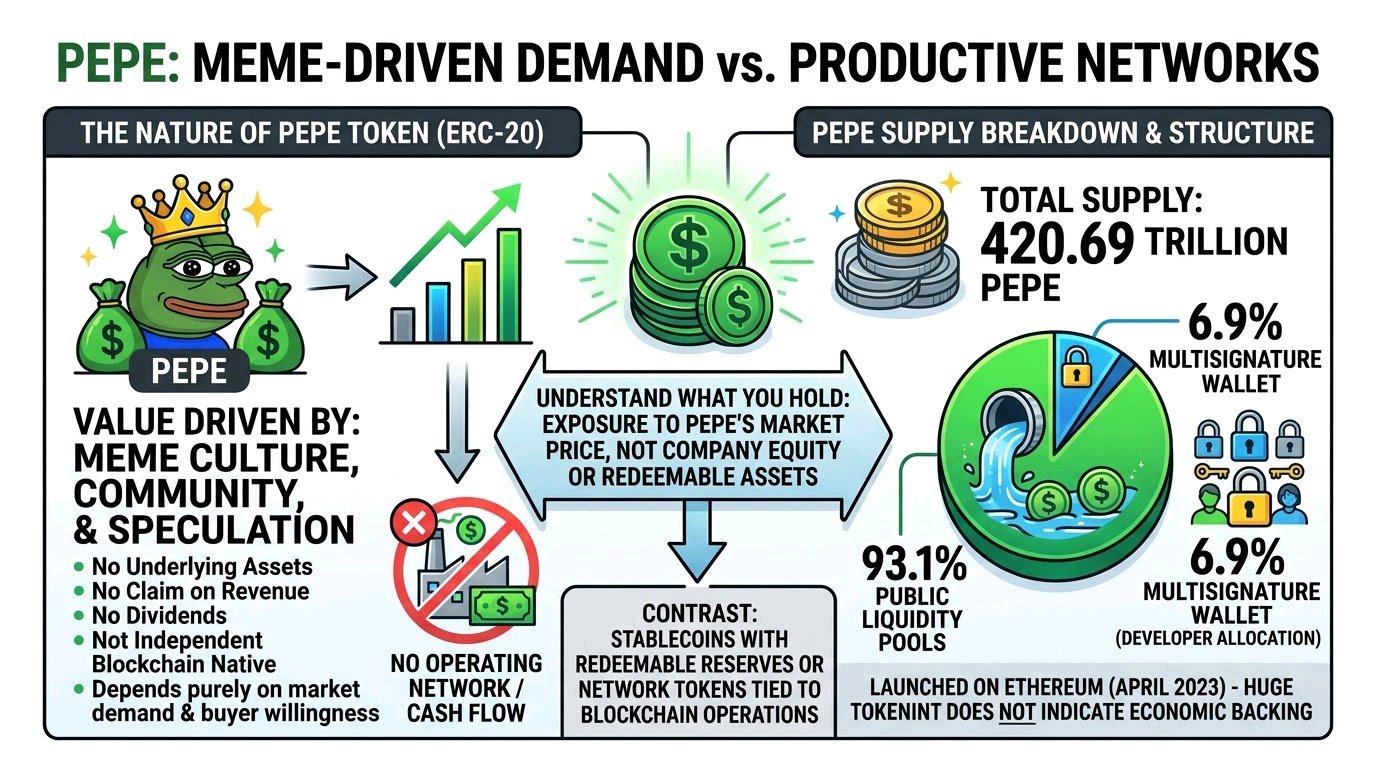
PEPE may look like a cryptocurrency with its own ecosystem, but its price is driven primarily by meme culture, market demand, and speculation—not ownership of a productive network or a claim on underlying assets. Launched on Ethereum in April 2023, PEPE created a fixed supply of 420.69 trillion tokens. Approximately 93.1% entered public liquidity pools, while the remaining 6.9% was allocated to a multisignature wallet. That distinction is easy to miss if you only read the headline. PEPE is an ERC-20 meme token, not the native asset of an independent blockchain. Holding it gives you exposure to PEPE's market price and community demand, not company equity, protocol revenue, dividends, or a right to redeem tokens for dollars or other assets. Its value depends on what buyers are willing to pay for the token. For scale, PEPE's 420.69 trillion initial supply is enormous, but token count does not represent economic backing. Unlike a stablecoin with redeemable reserves or a network token tied to blockchain operations, PEPE has no underlying cash flow or redemption mechanism supporting its valuation. PEPE is exposure to meme-driven demand, not ownership of an operating network. What matters is not the name, but what you are actually holding. $PEPEUSDT #ByXIMPACT
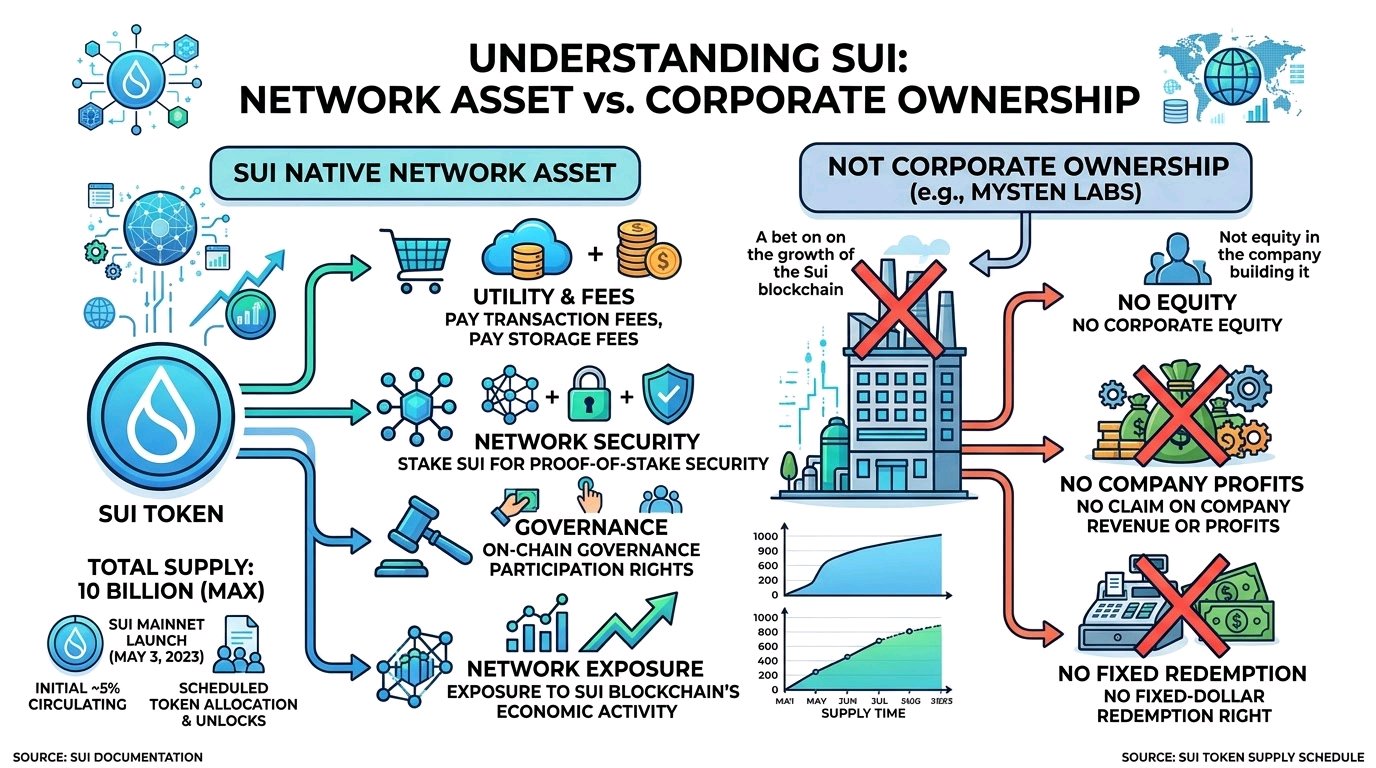
SUI may be described as a bet on the growth of the Sui blockchain, but it is not equity in the company building it or a claim on the network's revenue. The distinction is that SUI is a native network asset, not a corporate ownership instrument. Sui Mainnet launched on May 3, 2023, with an initial supply of 10 billion tokens created at launch. Only around 5% was initially circulating, with the remainder allocated for scheduled distribution. SUI Token Supply and Schedule +1 That distinction is easy to miss if you only read the headline. SUI gives holders exposure to the network's economic activity through several functions. It pays transaction and storage fees, can be staked to participate in proof-of-stake security, and provides participation rights in on-chain governance. But holding SUI does not give someone ownership of Mysten Labs, a direct claim on company profits, or a fixed-dollar redemption right. Sui Documentation +1 The 10 billion supply cap also matters. Unlike Bitcoin's progressive mining model, SUI's initial supply was created at network launch, with tokens distributed through allocations and unlocking schedules. This means market exposure depends not only on network adoption, but also on circulating supply growth and token demand. Sui Documentation +1 SUI is exposure to a blockchain's native economic system, not ownership of the company behind it. The difference is what you are actually holding. $SUIUSDT #ByXIMPACT
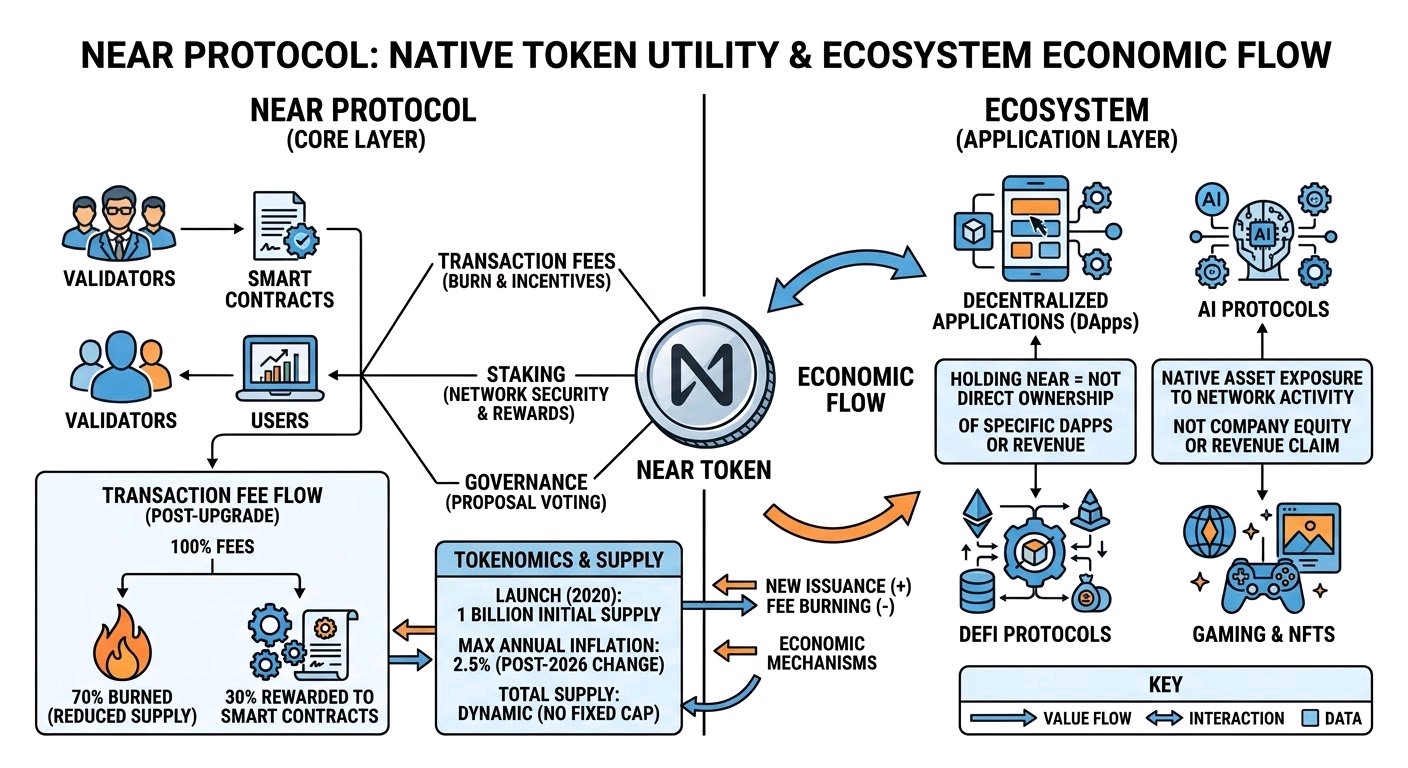
NEAR may be described as a bet on the growth of an AI-focused blockchain, but holding NEAR is not the same as owning a share of its ecosystem or its revenue. Launched in 2020 with an initial supply of 1 billion tokens, NEAR was designed as the native asset of the NEAR Protocol. Its tokenomics now include a reduced maximum annual inflation rate of 2.5%, following a 2026 protocol change. NEAR +1 That distinction is easy to miss if you only read the headline. NEAR gives holders exposure to the economic activity of the network through transaction fees, staking, and governance. Validators receive newly issued tokens for securing the blockchain, while 70% of transaction fees are burned and the remaining 30% goes to the smart contracts involved. Holding NEAR does not create a direct ownership claim on applications, company equity, or all revenue generated across the ecosystem. SEC +1 The scale matters. NEAR began with 1 billion tokens, but unlike Bitcoin, it does not have a fixed maximum supply. Its supply dynamics depend on new issuance, transaction-fee burning, and evolving economic mechanisms. NEAR is exposure to a blockchain economy, not ownership of everything built on it. The important distinction is what you are actually holding. $NEARUSDT #ByXIMPACT
XAUT may look like another crypto asset, but its value follows physical gold, not Bitcoin or a fixed-dollar peg. Launched in 2020 by Tether Gold, each XAUT token represents ownership rights to one fine troy ounce of physical gold held in Swiss vaults. Its value moves with the gold market, and redemption is subject to eligibility requirements, minimum amounts, fees, and other conditions. That distinction is easy to miss if you only read the headline. XAUT is not simply a digital dollar or a speculative claim on a crypto company. It gives holders exposure to allocated physical gold through a blockchain-based token. The underlying asset is gold, while the blockchain provides the system for issuing and transferring the ownership representation. By the end of Q2 2026, XAUT had 612,823 tokens sold, backed by approximately 22 tonnes of gold, with a market value of roughly $2.84 billion. This makes it a substantial tokenized-gold product, not another dollar-linked stablecoin. Tether +1 The distinction is simple: you are not holding a dollar peg or a Bitcoin-like monetary asset. You are holding tokenized exposure to physical gold. #ByXIMPACT $XAUTUSDT
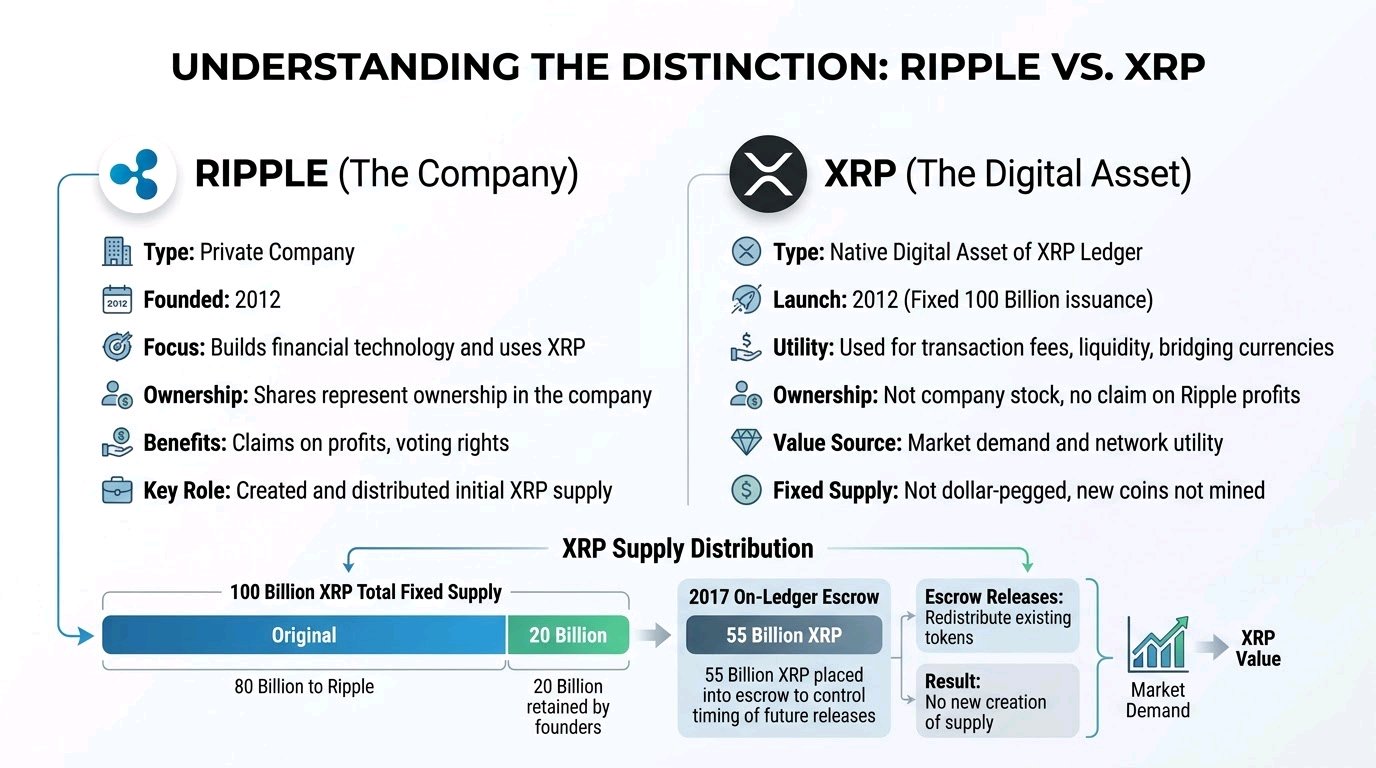
XRP may be viewed as a bet on Ripple, but it is neither company stock nor a dollar-pegged asset. Its value comes from market demand for a digital asset designed to facilitate payments and transfer value across the XRP Ledger. Launched in 2012, XRP began with 100 billion tokens created at inception. The founders allocated 80 billion to Ripple and retained 20 billion. In 2017, Ripple placed 55 billion XRP into on-ledger escrow to control the timing of future releases. XRP Ledger +2 That distinction is easy to miss if you only read the headline. Holding XRP does not give you ownership in Ripple, a claim on its profits, or a right to redeem tokens for a fixed dollar amount. You hold the native asset of the XRP Ledger, used for transaction fees, liquidity, and bridging currencies. Escrow releases redistribute existing tokens; they do not create new supply. The scale matters. XRP has a fixed original issuance of 100 billion, unlike Bitcoin, which distributes new coins through mining over time. Its market exposure depends on demand for XRP itself, its liquidity, network utility, and supply distribution—not direct ownership of the company building around it. XRP Ledger +2 Ripple is a company. XRP is a separate digital asset. The difference is what you are actually holding. $XRPUSDT #ByXIMPACT
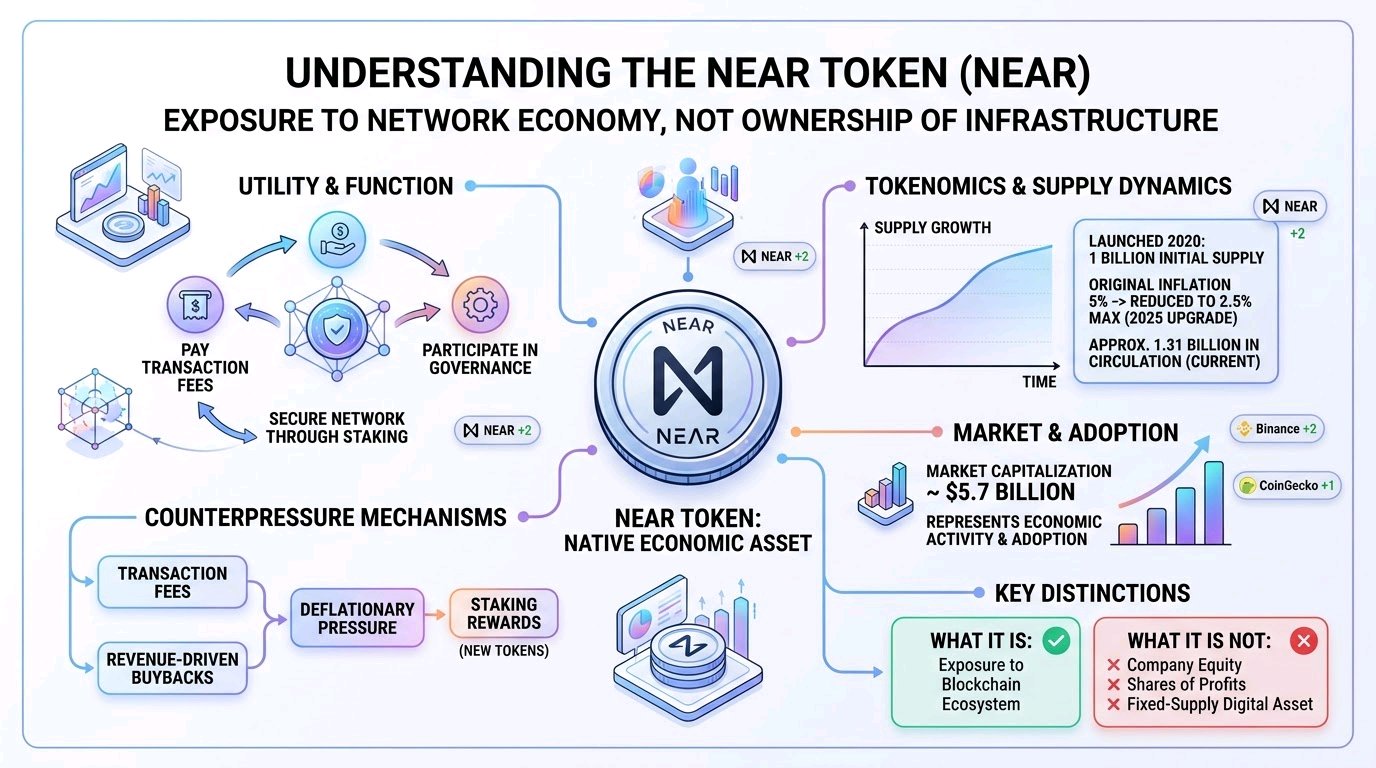
NEAR may look like a bet on an AI-focused blockchain, but its token is neither company equity nor a fixed-supply digital asset. NEAR launched in 2020 with an initial supply of 1 billion tokens. Its original annual inflation rate was 5%, later reduced to a maximum of 2.5% through a 2025 tokenomics upgrade. Its circulating supply has since grown to approximately 1.31 billion NEAR. NEAR +2 That distinction is easy to miss if you only read the headline. NEAR is the native economic asset of NEAR Protocol. Holders use it to pay transaction fees, secure the network through staking, and participate in governance. Validators receive newly issued tokens as rewards, while transaction fees and newer revenue-driven buyback mechanisms can create counterpressure on supply. Holding NEAR does not represent ownership of the NEAR Foundation, company profits, or a guaranteed claim on network revenue. Binance +2 At roughly 1.31 billion tokens in circulation and a market capitalization around $5.7 billion, NEAR represents exposure to the economic activity and adoption of an entire blockchain ecosystem, not ownership of the infrastructure itself. CoinGecko +1 The distinction is simple: NEAR is exposure to a network economy, not ownership of what you are actually holding. $NEARUSDT #ByXIMPACT
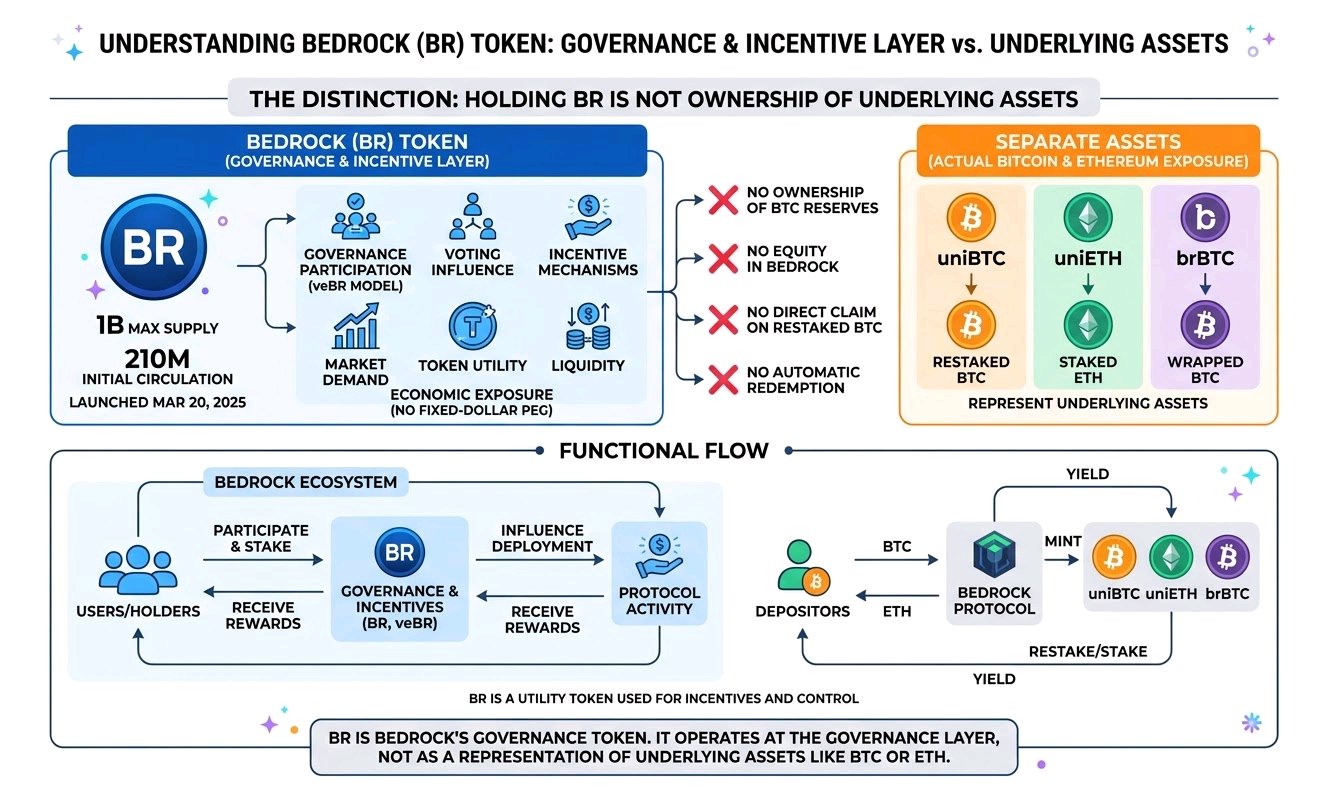
BR may look like a Bitcoin-related asset because of its connection to BTC restaking, but it is actually Bedrock’s governance and incentive token. Launched on March 20, 2025, BR has a maximum supply of 1 billion tokens, with 210 million initially circulating. At its token generation event, 50 million BR (5% of total supply) were offered for $1.25 million. That distinction is easy to miss if you only read the headline. BR does not represent ownership of Bitcoin reserves, Bedrock company equity, or a direct claim on restaked BTC. It has no fixed-dollar peg or automatic redemption mechanism. Instead, its economic exposure comes from market demand, token utility, liquidity, governance participation, and incentive mechanisms. Its veBR model also gives holders voting influence within the ecosystem. The actual Bitcoin and Ethereum exposure sits in separate assets, including uniBTC, uniETH, and brBTC. BR operates at the governance and incentive layer rather than representing the underlying assets themselves. The distinction is simple: exposure to Bedrock’s ecosystem is not ownership of its underlying assets. What matters is what you are actually holding. $BRUSDT #BybitStocks
HYPE may look like a bet on Hyperliquid’s exchange success, but it is not company stock or a direct claim on exchange profits. Launched on November 29, 2024, HYPE began with a maximum supply of 1 billion tokens, with 310 million distributed through its genesis airdrop to roughly 100,000 eligible users. Another 238 million were allocated to core contributors, subject to a multi-year vesting schedule. That distinction is easy to miss if you only read the headline. HYPE is the native token of the Hyperliquid ecosystem. It provides exposure to network activity through staking, governance, transaction fees, and protocol-related utility. Its economic model also connects protocol revenue to token demand: 99% of protocol fees are directed to the Assistance Fund, which purchases HYPE from the open market. However, holding HYPE does not give you equity ownership, guaranteed dividends, or a contractual claim on company earnings. With a 1 billion token supply and a fee-funded purchase mechanism, HYPE has a different economic structure from ordinary exchange tokens that rely mainly on market speculation. But future emissions, contributor unlocks, and actual platform activity still matter. HYPE is not ownership of an exchange. It is exposure to the network economy behind it—and that is what you are actually holding. $HYPEUSDT #ByXIMPACT