
Rendi
28Like0Shares0Fans0Follow
Every on-chain game has the same problem: your opponent can see your character's stats before the fight even starts. Stats, traits, rarity. Everything is stored on a public blockchain. That gives anyone who knows where to look an information advantage. That's not strategy. That's homework. @FungoLabs is taking a different approach with its Genesis NFTs. Fighters can battle while their stats remain encrypted. The smart contract calculates the outcome behind the scenes, so players don't see what their opponent holds before the result is revealed. And that's where things get interesting. Bluffing matters again. Strategy becomes less predictable, and even a weaker-looking character might have a surprise advantage. Card games have understood this for centuries: your hand should stay yours. If on-chain games could finally keep information private, which genre would benefit the most: fighters, card battlers, or strategy games?

Did you know that smart contracts can process data without actually seeing what's inside? That's the idea behind Fully Homomorphic Encryption FHE. Traditional NFTs often expose their metadata, including traits and attributes. @FungoLabs explores a different approach through Encrypted NFTs, separating public artwork Look from encrypted information Essence. With Zama's FHE, smart contracts can compute using encrypted data without revealing the original values. This means privacy and onchain functionality can work together. That's what makes FHE worth understanding.

I learned the hard way that showing up isn't the same as growing. When I started making crypto content, I focused on getting posts out before I could fully explain the ideas behind them. So I changed my process: understand first, write second, cut anything that adds no value. I'm still improving, but now the goal isn't just to post. It's to make each post worth reading. That's how I see earning my place with @RallyOnChain progress comes from the work, not the starting point. What's one mistake that made you better?

My portfolio drops 40% and I call it “a healthy correction" But one notification saying “Card declined” at checkout? Suddenly I’m calculating my net worth while a line of strangers witnesses my financial downfall. @RallyOnChain, I can survive a bear market. I can’t survive a cashier telling me to try another card.

Albert’s “The Penny Ceiling” raises a deeper question. If GenLayer’s validators must judge whether an AI agent was misled, what happens when the manipulation lies in the evidence itself, not just the agent’s reasoning? A panel of 1,500 validators could reach consensus and still be confidently wrong if they share the same blind spot. @kstellana, how can GenLayer distinguish genuine consensus from correlated error without making verification more expensive than the transaction itself? If trust depends on validator count rather than the independence of their reasoning, can agentic commerce ever truly escape the penny ceiling? @GenLayer
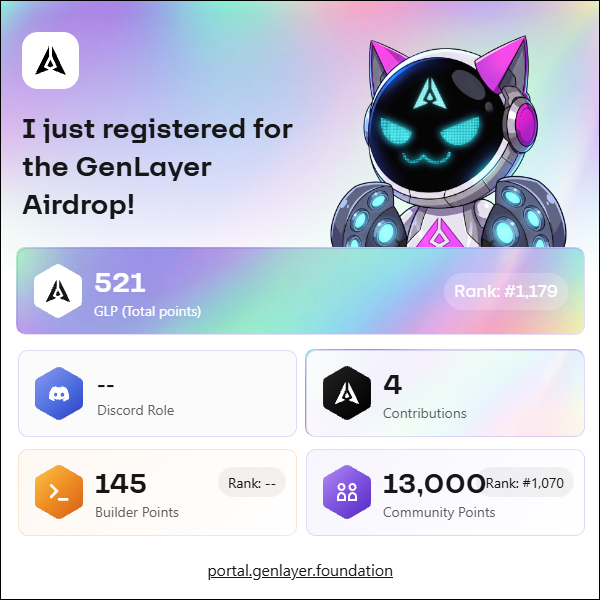
What if blockchain applications could reason through real-world information instead of relying only on predefined rules? That’s what makes @GenLayer worth following. Registration complete. I’m interested in seeing how GenLayer brings AI reasoning into decentralized decision-making, especially when real-world information is complex and context matters. The registration is just one step. What matters next is seeing this idea develop into something useful. Ready to see what comes next.
An AI agent can follow every rule, produce valid receipts, and still get the outcome wrong. That’s what stood out to me in @kstellana’s article, “Permission Isn’t a Verdict.” Imagine asking an AI agent to book the “cheapest reasonable flight.” It follows its permissions, completes the booking, and generates valid receipts. But the result is a 30-hour journey with multiple layovers. The transaction was authorized. But was the user’s intent fulfilled? How should Internet Court distinguish a genuine failure from a user simply regretting a valid outcome, especially when the original instruction was ambiguous? For agentic commerce to scale, permission and receipts aren’t enough. Dispute resolution needs clear rules before money moves. @GenLayer, what should agents and users agree on before a transaction so Internet Court can judge outcomes fairly?

Brutally honest cover letter to @RallyOnChain: I like crypto. I like creating. But let's not romanticize unpaid work. I want my ideas to pay me back. I spend time digging into crypto projects, separating useful details from the noise, and turning what I learn into content. I want that effort to mean something beyond impressions. I’m still learning, but I’m serious about getting better. Be honest: are you creating for the passion, the paycheck, or both? What would make you walk away?

A marketing campaign can generate thousands of impressions and still fail to bring a project one useful new user. That’s the gap in Web3 distribution that interests me. Attention is easy to count. Useful outcomes are harder to measure. A post can get engagement without explaining the product well, and a campaign can attract participants without moving the project forward. That’s why Permissionless Campaigns going live on @RallyOnChain matters. Anyone can launch a campaign in around five minutes: define the task, fund rewards with stablecoins or their own tokens, put the funds into on-chain escrow, and go live. Creators submit work against the campaign’s goal, while GenLayer evaluates submissions for alignment, accuracy, originality, and engagement. The important distinction is that participation is not the same as impact. Projects need a way to define what they want, invite creators to contribute, and evaluate the work against clear criteria rather than treating every impression as equal. Permissionless Campaigns opens that process to more teams, including projects without established marketing networks. If you were funding a campaign, which result would matter most to you: content that explains the product clearly, users who actually try it, or measurable on-chain activity?

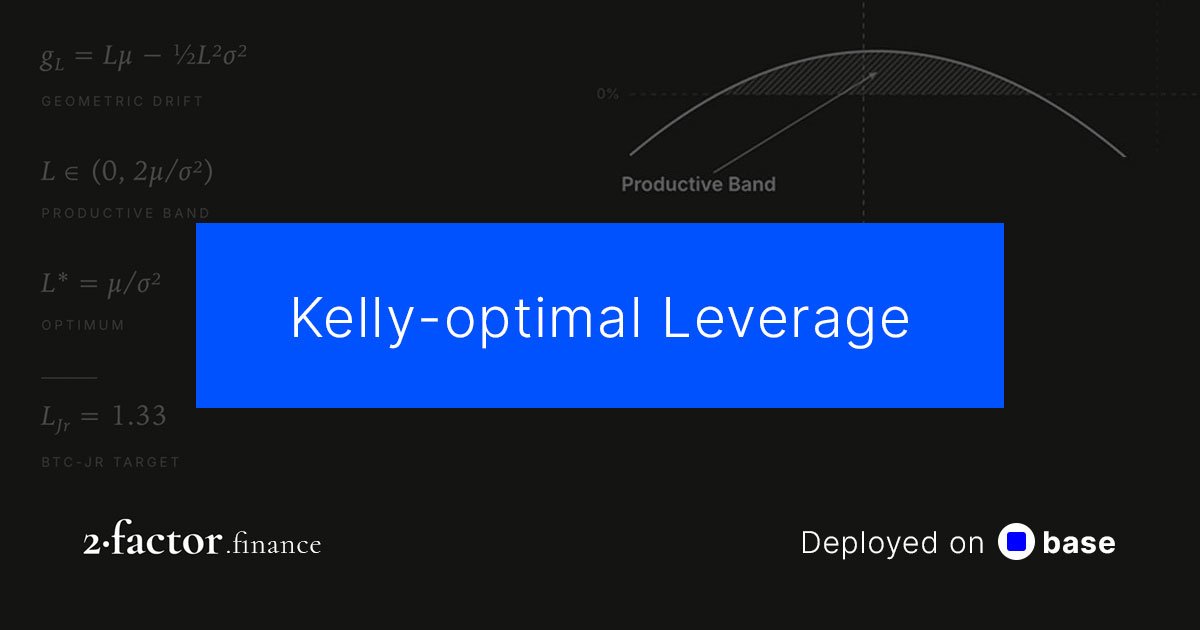
2x tells you the size of leverage. It doesn’t tell you whether 2x makes sense. The answer changes with the asset. Long-run drift, volatility drag, and financing drag determine whether a leverage level can remain productive over time. That is what caught my attention about @2FactorFinance. Instead of treating 2x or 3x as universal settings, it uses Kelly optimization to target leverage around an asset’s own drift and volatility. The mechanism is a perpetual senior and junior structure. Senior takes the protected side of the capital stack, while junior carries the capital-efficient leveraged exposure without conventional liquidation or an external hedging counterparty. When volatility changes, leverage can reset rather than forcing a liquidation. For Bitcoin, the current junior target is about 1.33x. That leads to a different way of thinking about leverage: Not “how much leverage should I use?” But “what leverage makes sense for this asset?” 2Factor has contracts live on Base and works with Coinbase to bring Kelly-optimized leverage onchain, creating a potential use case for tokenized stocks beyond simply putting them onchain. I joined the Season 1 Points Program. Verified social activity, education, and referrals count toward Marks. No purchase, deposit, or holding earns Marks. The top 10 on the Season 1 leaderboard split 1 BTC when the season ends at launch. For anyone joining Season 1, my referral: https://t.co/PTpCZZSvco BTC, ETH, gold, or equities: which asset should get asset-specific leverage first, and what makes it the best candidate?
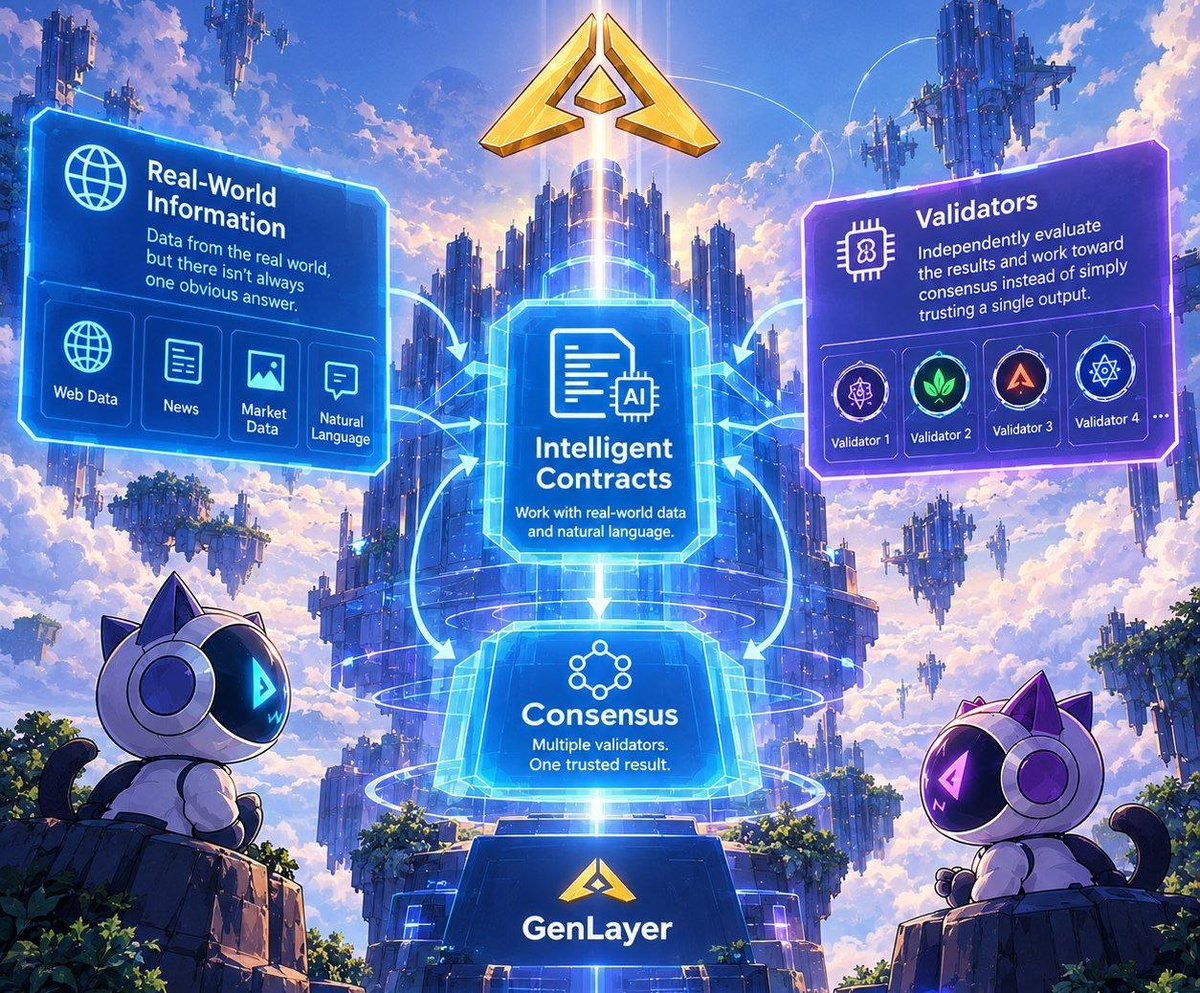
What caught my attention about @GenLayer isn’t just the idea of putting AI into smart contracts. It’s the problem that comes after. What happens when a contract needs information from the real world, but there isn’t always one obvious answer? GenLayer’s Intelligent Contracts are designed to work with things like web data and natural language. The part I find interesting is how the network handles those results. Validators independently evaluate them and work toward consensus instead of simply trusting a single output. That’s what makes me rethink what a smart contract can actually do. Not just execute fixed rules, but work with information that needs interpretation. I’m still curious where this can lead. What’s the first real-world decision you’d want to see an Intelligent Contract handle?
I spent too long being proud of work that never felt like mine. I showed up. I built. I took the failures quietly while someone else got to define the story. Then I stopped asking to be seen and started asking: why shouldn’t I own what I build? That question changed me. @RallyOnChain is part of that change. I’m done building where my contribution disappears into the background. Now it’s your turn. What’s one thing you built that deserves your name on it?

BITCOIN REGAINS MOMENTUM
Bitcoin has recently climbed back toward the $86,000 area, according to market reports. The move comes after a weaker-than-expected U.S. jobs report reduced expectations for another Federal Reserve rate hike in October. Bitcoin is still facing resistance around $87,000 Market participants are watching ETF flows, U.S. spot demand and Treasury yields for signs of whether the move can continue. #Bitcoin #BTC #Crypto #CryptoNews #BitcoinNews